
i finally watched before sunrise
the joy of plotlessness and the hidden messages in fiction

I’ve always known I would like Before Sunrise. Rarely do I hear of a movie that I would more obviously like. But it takes me about twelve business years between being told to watch a movie and finally doing it. For some strange reason, actually watching a movie seems to take all the time, consideration, and planning of getting a tattoo.
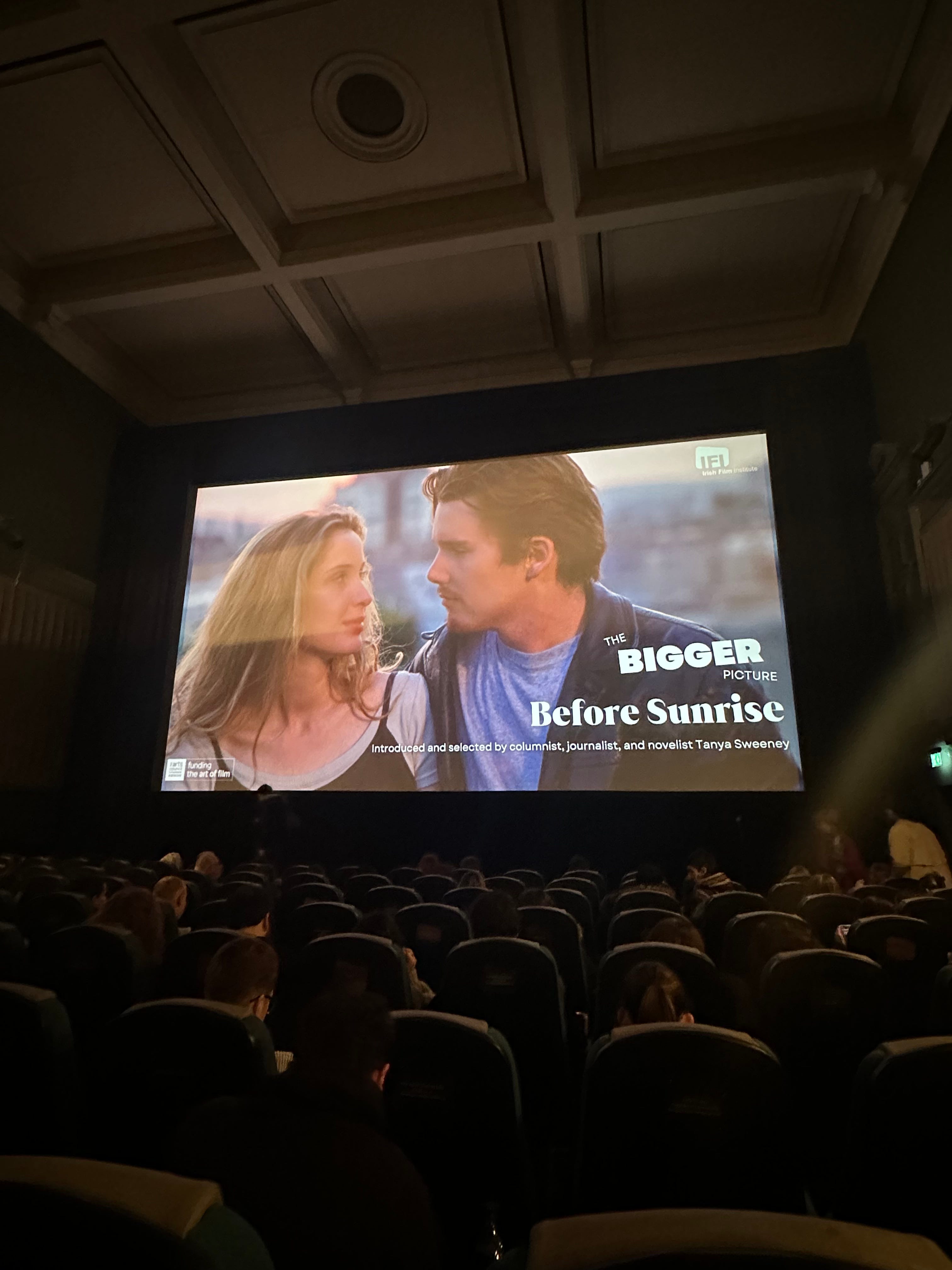
But the IFI was showing Before Sunrise in some kind of artsy throwback series, and Elena was going, and seeing it in a theater environment, a gift as a viewer and an interesting exercise as a critic—knowing I could only keep what I scraped from the screen into my brain on the first go—seemed right. I watched, eyes wide, knowing I’d only ever see it for the first time once. As we walked out of the theater, Elena asked me what I thought, and I said, I think I somehow watched the movie at the exact moment it would have the most impact.
It was beautiful and also like a rusty nail.
For anyone unaware, Before Sunrise is the 1995 film from director Richard Linklater (who was apparently born in the same city I was, Houston) staring Julie Delpy and Ethan Hawke. Their characters, Jesse and Celine, meet on a train. Jesse is getting off in Vienna to fly back to the States in the morning. Celine is heading on to Paris. Celine sits down across from Jesse, and they strike up a conversation. When it’s time for him to get off the train, he asks her to go with him. The film rides on this first spark of intellectual chemistry, and they spend one long night together before they have to go their separate ways. The film calls into question the classic romantic trope of the happily ever after, instead asking what it means to find an incredibly powerful connection with another person that you’ll never see again. Can there be significance in something so ephemeral?
Before Sunrise is nothing more than a tapestry of wildly intense, fascinating conversations set against various backdrops across Vienna—a cafe, a floating restaurant, a club, a ferris wheel, the river walk, a graveyard, the park. And it is solely through these conversations that we fall in love with Jesse and Celine and they fall for each other. Each conversation is deeply entertaining in itself as they jump straight into the big ideas of the world with the freedom that nothing they could say or do will ruin the singular night. They skim past the niceties and nothingness that usually pervades conversations with strangers.
In the train car, Celine talks about her ambitions in life and how her parents always reframed them. She wants to be an actress, they say newscaster. She wants to open an animal rescue, they say veterinarian. She wants to be a writer, which is revealed as her genuine passion as she later talks about stories she’s written, and they say journalist. This bit made me laugh. My mother tried to get me to study journalism. She still thinks I’ll end up a journalist. And Celine makes an interesting point—most people’s impulse is to take a wild dream and, rather than chase it, they settle for something that fits in the box. That is legible, comprehensible, attainable. Celine has scaffolded her life in opposition to this as she later talks about rebellion being healthy, even against your perfectly nice parents. Jesse is more opaque as a character. He clearly has a creative impulse based on his zany idea to run a cable program capturing the mundanity of life, but he’s not as uninhibited as Celine, nor as driven. While he initiates them spending the night together, that is where his capacity to drive things ends. She is the one propelling the story, and she has an openness that he seems to admire but not be able to reach in himself.
This is maybe best illustrated in the scene where the palm reader approaches Celine at the cafe, and she plays into it, listening attentively as the reader tells her she’s an adventurer, a seeker, she’s interested in the power of a moment and that she’s becoming a strong, creative woman. But she warns that Celine has to find peace within herself to find true connection to others. Then she surmises that Celine doesn’t know Jesse and picks up his hand, which he gives reluctantly, and all she says, with a laugh, is, “You will be alright, he’s learning.” He is obviously offended by this, which only causes him to double down on his belief that all the mysticism is bullshit. He struggles to accept the romantic whimsy of it all, to be able to take what resonates and let the rest go. He has to be right about it all being a scam, similar to when they encounter the poet who later writes them a love poem with the word “milkshake” and Jesse has to posture that the poem was prewritten with the word inserted after the fact. Despite being on this magical, strange night and having a certain amount of intrigue towards the strange happenings, he still has to stifle the romantic impulse in himself. It isn’t cool to be earnest or openly curious about the world, though it’s that trait in Celine that draws him to her.
Similarly, his inability to fully surrender to the moment holds him back in their relationship. He clearly likes her, but he often drowns in his own head. He pulls back when he needs to step closer. He fumbles around with his words when they drift nearer to the shores of reality and away from the heady, philosophical conversations. Every time that they kiss, she’s the one that initiates it. She says “you want to kiss me” or “I want to kiss you.” There’s an interesting version of this movie, I think, in another world, where neither of them are willing to stab a finger at that styrofoam wall despite having scaled the much larger obstacles. It’s only in Celine’s uninhibitedness that the full spectrum of the romance unfolds.
The moment where Celine gets caught in her mind is when they’re in the park and Celine announces that she doesn’t want to sleep with him. They go back and forth about this, and it explores an interesting concept. We have our standards in theory, which is what she’s trying to exercise at the beginning of the conversation, and our standards in practice. Celine originally says she doesn’t want to sleep with him because then the meaning of the night shifts. The narrative goes from this strange, magical, liminal night to ‘I got laid in Vienna.’ She flattens herself in this story into ‘this French girl.’ The way she frames it, sleeping together in this circumstance will make them more like two strangers, not less. Still, though, she feels compelled towards him, and she struggles in the moment between what she sees as the correct answer—what is maybe the more defensive position—and what she feels is following her true desire, that she can make herself vulnerable in that way without it cheapening what came before. There’s a certain choice that has to be made, or maybe intuited, on whether to trust this stranger.
While the emotional experience of watching the film is undeniably rich, it’s also fascinating from a storyteller’s perspective in its careful construction because it manages a true feat, one that thrills me like no other—it is a plotless story that works. It might be one of the most structureless, dynamic, open, character-driven pieces of art I’ve ever seen. After the inciting incident where he asks her to get off the train, the film dispenses with classical narrative beats. It holds tension with no external forces pulling the puppet strings. When they argue, it’s only playful. The viewer goes in knowing that these two people will part ways in the morning and never see each other again, no matter what happens in the time in between. (Yes, I am ignoring the fact that there are two sequels). What happens on this one night inherently doesn’t matter in a classical storytelling sense because it will have no tangible impact on the rest of their lives. But it works because these characters feel so real, so embodied, and you hang on their every word and come to understand that even if their lives are not materially different for this night having happened, they will both be inexorably changed by one another. And we get to watch that unfold in real time. Linklater only pulls this off because of his extreme trust in both what he has in the story he’s telling and in the viewer. Before Sunrise is the ultimate in an artistic trust exercise.
So much of the movie is delivered in subtlety and physicality. The attraction, beyond the actual content of their conversation, is immediately transmitted to the viewer as we watch them take turns playing with the salt shaker that sits between them in the dining car. It’s a nervous tick, but it’s also an excuse to extend a hand closer to one another. They’re mirroring each other’s behavior as they take turns fidgeting with it.
Ethan Hawke’s physicality is also incredible. His character comes through entirely in the little movements—the moments where he starts to stretch his arm around her and pulls back, the little sheepish looks. He got her to get off the train, but he’s still so hesitant, so easily spooked by the whole thing. He wants this night, but he’s also scared of something that feels this real, and we learn that entirely through his mannerisms. How intensely he’s invested in the pinball game when they venture into discussing their past relationships. How he’s there, and he’s vulnerable, but it’s scaring the shit out of him the entire time. And that’s never once imparted by the vague bits of backstory or really by his dialogue. It’s absorbed by watching Jesse move through the world. This is one of the main advantages film has over prose.
Before Sunrise is also the shining example that the essential ingredient in driving a story isn’t plot—the random series of events—it’s tension that’s in the register of the emotionality of the piece. And that’s what Linklater builds here, playing with every possible facet of: I’m having really intense feelings for this stranger I just met and will never see again.
But it takes trust to hold your story in that space. One of the scenes that best illustrates the glory of this is when they go into the listening booth at the record store. They’re in a confined space, listening to this awkwardly slow, romantic song, and Linklater just lets it play and play and play as they stand in that kind of silence that just makes you want to burst out laughing. And we watch them glance over at one another, wonder if maybe they’ll kiss, if something will happen, but it doesn’t. They’re never looking at the same time. They never catch each other’s eyes. I’m not sure it was intended this way, but it’s an interesting show of their inherent misalignment that would only become obvious if they had more than a night
Linklater also plays with the artifice that we employ to talk deeply to one another. They’re exhausted and a little drunk by the time their conversations aimlessly wander, by the time they talk directly about one another. Before that, there’s always some intermediary that allows them to be honest and unguarded: the question game he starts as they head into the city, the phone game they play pretending they’re calling their best friends, the pinball. Even the philosophical nature of their conversations plays into this, their theoretical arguments are a certain method of obstruction. There’s things in the undercurrent that they’re hoping to communicate, but they’re safe because they’re not looking the eclipse in the eye. There’s plausible deniability. This also adds to the tension because the games make more transparent the layers of what’s being said, what’s not, and what they’re hoping the other person understands.
Tanya Sweeney introduced the movie by asking how many of us weren’t even born in 1995 when Before Sunrise first came out. It was most of the audience, myself included. So she described what dating was like in Dublin in 1995. How you’d dance in front of someone at the club, make out, go home with them, and repeat this five weekends in a row until you were dating. Honestly not far off the banal reality of dating app culture today—maybe, really, slightly more romantic. She talks about Before Sunrise being mind-blowing to her 18-year-old self seeing it in theaters for the first time. That love and romance and intellectual chemistry like that was possible. Rare but possible.
What does it mean to have a connection like that and lose it?
In a way, it means that the moment will always be perfect, the person will ruin everyone else for you because the abrupt ending crystalizes them in their best form, in a way. Thinking back on my own Before Sunrise moments—the more mundane versions that happen in a random room at nine in the morning or in a truck bed at two a.m., that flicker of a spark that could really be something, the beautiful, uninhibited, meandering, heady conversations, the things that rearrange the furniture in your mind in small margins, that you’ll replay for the rest of your life—they’re more beautiful for being unfinished. Losing the love protects it.
It’s never ruined by the grossness of real life, the misalignments in priorities and upbringing, stupid arguments about dirty dishes and bills. Like Jesse says, the mannerisms that would drive you crazy if you lived with them for eternity. You never do the hard stuff together which, sure, adds texture and depth and hard-fought accomplishment to a love, but it also makes it easier to see it realistically and let go when the connection has run its course. What’s rendered in Before Sunrise, while deeply romantic, is thin and untested. The fact that it must end before it truly begins dulls out the impracticalities, the misalignments that wouldn’t hold up outside of the liminal soup.
They’re the love you never quite let go because you never fought over socks or realized they had some disconcerting views or were downright insufferable. The person is gone but the stamp of what they left in your life is there, the ways they changed you with their thoughts, with the prism their gaze refracted you through. And, usually, these changes make you wish you could fight about socks with this person, understand the rhythm of their mundane. That’s the part that hurts.
But Linklater puts Celine on the train at the end of the movie, sends Jesse down the escalator at the airport. They don’t run back for one another. Vienna is retraced, empty, without them. The last shot is her melancholy stare out the window, the hollow eyes of trying to process the magnitude of what was had and lost.
In Tanya’s introduction, she also spoke about the meta layer to this film. Linklater had met a woman in a toy store in Philadelphia. They had the kind of connection that Jesse and Celine find and spent the night wandering around the city. The two parted ways and fell out of each other’s lives, but when Linklater turned that experience into Before Sunrise, he secretly hoped that Amy might go to the movie, see herself in Celine, and come back into his life. This secret, personal wish baked itself into the core of the film, crafted for the hopeful audience of one. In a twist that’s movie-like in itself, Amy died in a motorcycle accident a year before the movie came out. She would never see the film and receive the message.
This struck me as a writer, as someone who borrows heavily from my own life, from moments that haunt me and people like Jesse. I know I don’t write in this way with Linklater’s designs. I’m not hoping that someone will recognize themselves—I usually actively hope they won’t—and reach out with a new depth of understanding. But I do love that in rendering artistic crystallizations of these most important people and moments, there is a chance, if someone recognizes themselves in the text, to say: you mattered to me. You shaped my world. You changed something—things we never get to say out loud, or, at least, that I won’t. But it can be there, in the work. You mattered, this mattered.
I love this! One of my favorite films ever--foundational. I saw it in the theater when it came out :) I do still want to write books that feel like this movie.